


Student Affairs Facilities and Operations helps build the student experience

College campuses sometimes feel like they're in a constant state of construction. Student Affairs Facilities and Operations approaches renovation projects with a clear purpose of enhancing the student experience.
The recent opening of Choolaah, an Indian BBQ in the Hokie Grill, highlights the essential role campus facilities play in creating a welcoming and accessible environment for students. The concept opened in Hokie Grill at Owens Hall in March and quickly gained popularity in the community.

From idea to grand opening
Bringing Choolaah to life was a sprint. Student Affairs Facilities and Operations worked with Dining Services to turn the concept into reality in record time.
“When bringing a new concept, we try to ask as many people as we can and get the student voice involved. We have a student advisory committee, and dining leadership looks at what concepts we already have and what we are missing,” said Gabe Petry, assistant director for Dining Services who oversees Owens Dining Center.
Choolaah is the university’s first full-time Indian dining concept, created to better serve the international student population while offering something new to the Blacksburg campus community.
Once Dining Services decided on an Indian barbecue concept, it put out bids to find the company that best matched the idea. Upon choosing Choolaah, the clock started.
“Dining tells me what they want, and I'm brutally honest with them on how long it's going to take to do it,” said Mason Montgomery, assistant director for planning and project management. “We did this project in just a few months.”
“The pace of the project was exciting, Petry said, noting that progress moved swiftly despite the project's complexity. "Some projects are so long that you don't even remember what it looked like when you started. With this, I could just close my eyes and imagine it.”
Maintaining the student experience
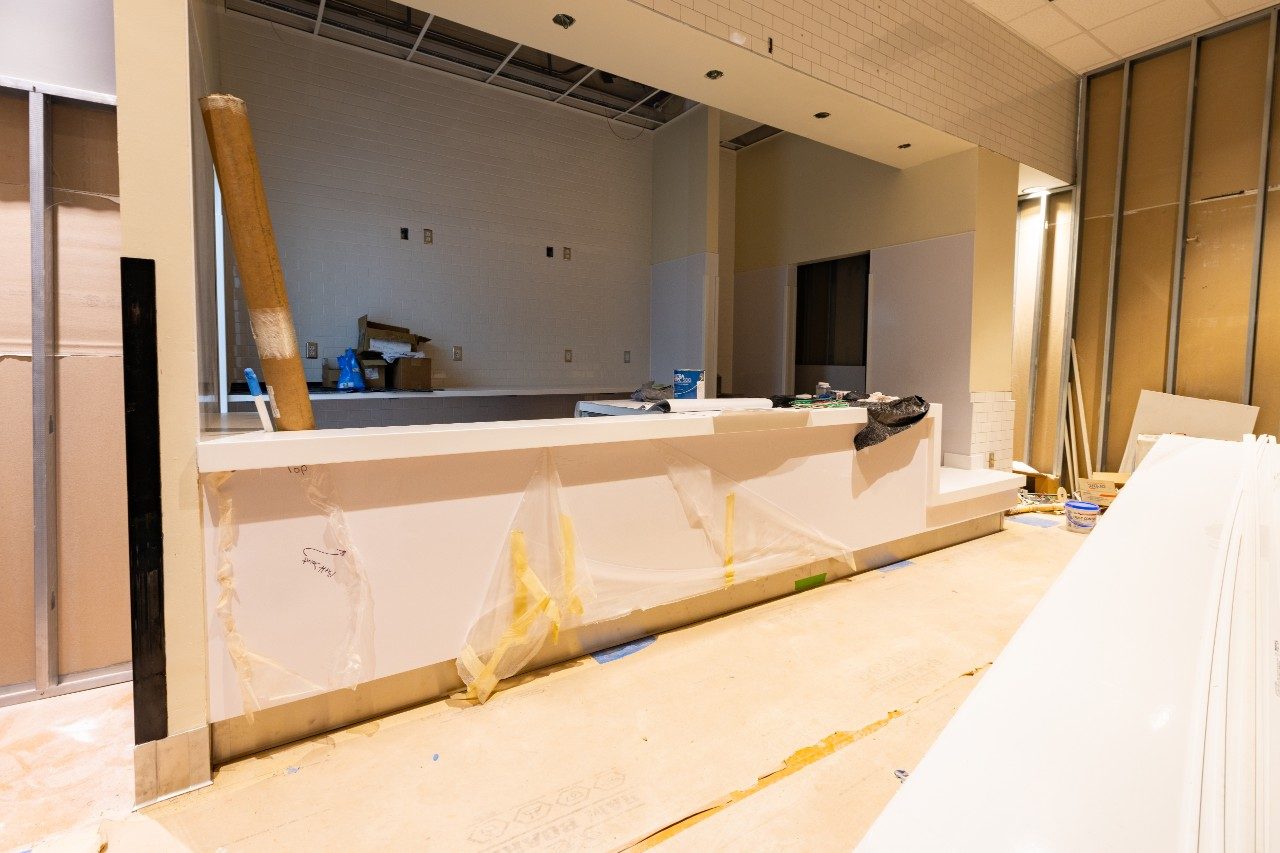
Construction underway on the future home of Choolaah Indian BBQ, with no trace of the former venue remaining, as Student Affairs Facilities and Operations begins renovations. Photo by Darren Van Dyke for Virginia Tech.

Student Affairs Facilities and Operations maintains residence halls, student centers, dining halls, and other Student Affairs facilities. The team is dedicated to minimizing disruption in these high-use, residential spaces.
“We plan to execute our projects during the summer and winter breaks to minimize the impact on the students’ experience during construction,” Montgomery said. “We focus our efforts on design, bidding, and pre-construction planning while students are on campus. We started on Choolaah in late December, and we were pretty much done by March 1.”
Petry said construction contracts limit noise to align with student schedules. “We tell them they can make all the noise they want during winter break, but then once students are back, they’ve got to live in a bubble.”
Some trades came in at night to avoid interfering with daily operations.
“By 6 a.m., they're done for the day, and they have to clean up,” Petry said. “Then, the dining staff would show up, clean the space again, and start making salads and wraps to serve that day.”
Other venues in Hokie Grill continued serving students after winter break while the team wrapped up the Choolaah construction and prepared for the grand opening.
“We built a dust partition around the project so our teams could work while dining was still serving students,” Montgomery said.
Challenges and collaboration

The space to build Choolaah’s kitchen was limited, requiring creative solutions. The teams transformed a tangent space off the current Hokie Grill kitchen, formerly part of the catering department in Owens' kitchen.
“The kitchen work was more complicated than the part people see,” Montgomery said. “Every dining facility we have is tapped out, electrically. On Gabe's side, the big part was sourcing the equipment. My team had figure out a way to make it work with plumbing, electrical, fire and life safety, and ADA [Americans with Disabilities Act].”
The customer-facing area of Choolaah is the tip of a food service iceberg. With 14 pieces of equipment in the kitchen area, every inch mattered.
“The architecture-engineering firm had to come out and measure things down to the half-inch, sometimes to the quarter-inch, to make sure the equipment all fit under the hood,” Petry said.

“The cool thing was seeing those long lines that we had on those first few days. It was everybody. It was a whole mix of students and faculty and staff,” Petry said.
“We enjoy watching the students enjoy what we've worked so hard to complete. That's fun. It's fulfilling when you walk up there and there's 50 students waiting in line to get something that you just finished,” Montgomery said.
“Better yet,” Petry said, “when they get their phones out, they're taking pictures, and you can see people furiously texting — maybe somebody here on campus, maybe somebody back home, somebody at a different university — look what we have at Virginia Tech.”

