


College of Science Magazine


The College of Science cares deeply about enriching, strengthening, and elevating our teaching and learning communities. Through research, practice, and follow-through, our students develop a passion for science and an understanding of why it matters.


Healthy Lives
-
Article Item
 Why some cancers are worse than others , article
Chromosome numbers and cell size fuel cancer progression, according to new studies published in the Proceedings of the National Academy of Sciences and Cancer Research.
-
Article Item
 Researchers find new approach to reversing chronic pain , article
In a new study published in PAIN, researchers in the School of Neuroscience erased well-established pain behaviors by shutting down an enzyme system that produces molecules known to amplify pain signals. This finding could open the door to the first new class of non-opioid chronic pain treatments in years — a potential lifeline for patients whose symptoms defy standard drugs.
-
Article Item
 Research findings may lead to earlier diagnoses of genetic disorder , article
Researchers discovered an indication hidden in the brain that may help doctors identify children with a rare genetic disease earlier.
-
Article Item
 When memory fades: A researcher seeks to understand aging , article
Inspired by her family’s experience with dementia, graduate student Brieann Brown is exploring how something called epigenetics could protect memory and improve quality of life for future generations.
Page 1 of 2 | 5 Results

Impact & Outreach
-
Article Item
 Virginia Tech Science at the Thomas Jefferson National Accelerator Facility , article
Q and A with Dean Kevin Pitts about what this new partnership might mean for Jefferson Lab and for Virginia Tech.
-
Article Item
 Michael Hochella elected to National Academy of Sciences , article
Hochella '75, M.S. '77, a University Distinguished Professor Emeritus, joins Robert J. Bodnar, Shuhai Xiao, and Patricia Dove to become the university's fourth geoscientist elected to the National Academy of Sciences.
-
Article Item
 Statisticians help ensure safety in space , article
Statisticians Geoff Vining M.S. ’86, Ph.D. ’88 and Anne Driscoll M.S. ’07, Ph.D. ’11 were part of a team honored with the Group Achievement Award from NASA.
-
Article Item
 CAREER Awards , article
The Faculty Early Career Development (CAREER) award is among the National Science Foundation's most prestigious awards in support of early-career faculty who have the potential to serve as academic role models in research and education and to lead advances in their field.
Message from the dean
Our science, near and far
There are those of you who will remember when Virginia Tech was largely known by outsiders as “that public school in Southwest Virginia.” We were regionally important, and that was significant.
Look at us now, though. We certainly have not turned our heads from making an impact in Southwest Virginia, in addressing challenges in our own community and across the Commonwealth. Look at our work on something like chronic pain, an issue for many in our community; children with autism; or cast your eyes over to Newport News, where Virginia Tech is now helping manage the Department of Energy’s Jefferson Lab.
But as Virginia Tech has grown, we’ve dispatched our impact and expertise to address important scientific issues locally, regionally, nationally, and globally. We have an impact at a global scale.
In this year’s Science magazine, we’ll both show you and tell you about some of the places in which our science is making a difference.
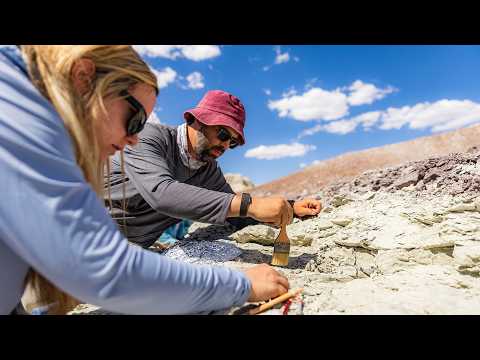
We’re so proud of this work that we made an effort to bring you an up-close look at one of those stories about research, undergraduate education, and our place in understanding the world’s history by sending a team on a fossil dig in the Arizona desert. I think the cover photo is awe-inspiring.
It’s been just a little more than two decades since the Virginia Tech College of Science came into being. The University’s success is directly tied to that of our scientific research, and just as importantly, our innovative ability to train the next generation of scientists.
It’s important work for our future, and I think you’ll agree that the Virginia Tech College of Science is ascending at an ideal time to tackle it.

April 14th, 2025 - Students in Ann Steven's microbial physiology class wade into the Duck Pond to collect and ignite methane gas created by microbial organisms. (Photo by Luke Hayes/Virginia Tech)
