UPWARDS TechTrek Summer Camp exposes high school students to excitement of engineering

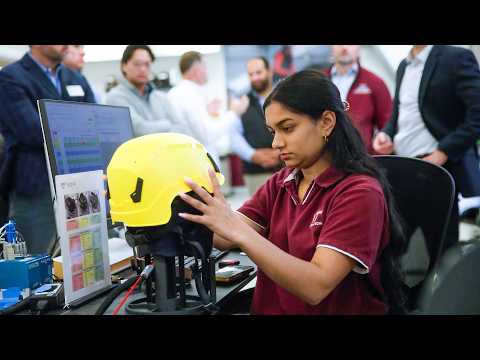
Designing electronic circuits. Programming digital hardware. Building robots. And even working with drones in an indoor testing cage.
High school students put all of those skills to work this summer during the UPWARDS TechTrek High School Summer Camp, which is part of the U.S.-Japan University Partnership for Workforce Advancement and Research and Development in Semiconductors, or UPWARDS led by the Bradley Department of Electrical and Computer Engineering (ECE). The partnership brings together 11 universities in the United States and Japan to help develop the next generation of the semiconductor workforce while advancing semiconductor and integrated-circuit research.
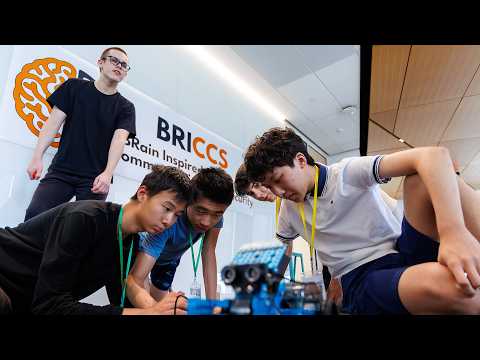
The two-week, project-based camp, led by computer engineering professor Yang (Cindy) Yi, introduced 90 rising 10th-, 11th-, and 12th-grade students to electrical and computer engineering and computer science through hands-on projects, demonstrations, competitions, and conversations with Virginia Tech experts and industry guest speakers. The summer camp is hosted by the BRain-Inspired Computing, Communications, and Security (BRICCS) Lab at Virginia Tech’s Academic Building One in Alexandria.
“What makes the TechTrek Camp so valuable is its emphasis on students working together to tackle difficult problems – an approach that aligns perfectly with the Institute for Advanced Computing’s experiential learning mission,” said Kirk Cameron, managing director of the Institute and a professor of computer science.
The high school students attended one of two sessions held July 20-31 and August 3-14, 2026. Most came from the greater Washington, D.C., area, though some traveled from as far as Texas and Washington State to take part.

Throughout the camp, students explored semiconductor, chip design, field-programmable gate array hardware, robotics, artificial intelligence, and machine learning. Their lab projects connected concepts introduced in lectures to working hardware, giving students opportunities to build, program, test, troubleshoot, and improve their designs.
They also learned more about Virginia Tech programs in electrical and computer engineering and computer science, interacted with industry representatives and academic guests, participated in competitions, and explored facilities in Academic Building One, including Institute for Advanced Computing labs.
The program and camp culminated Aug. 14 with a workshop and awards ceremony, which gathered more than 200 participants, families, mentors, and guests, including UPWARDS sponsors Micron Technology Inc., Tokyo Electron, and the National Science Foundation. The event opened with student project presentations and concluded with awards recognizing achievement, teamwork, and growth.
“I want to say congratulations to each of the students being recognized today. Your curiosity, hard work, and willingness to take on new challenges are exactly the qualities that drive innovation and create opportunities for the future,” said Amy Henecke, senior manager, Northeast University Semiconductor Network, Micron. “Programs like UPWARDS TechTrek play an important role in helping students explore STEM pathways, build confidence, and see themselves as future engineers, scientists, technologists, and problem solvers. We look forward to seeing the amazing contributions you make to your communities, to STEM, and perhaps one day, to the semi-conductor industry at Micron.”
Rick Turner, executive vice president, chief financial officer and general manager of administration for Tokyo Electron U.S. (TEL), who received his bachelor’s degree in finance from Virginia Tech, introduced TEL and the growing semiconductor industry to the students and their parents. “This is the best industry to be in if you are an engineering grad,” he said.
Each student also recorded a video about a favorite part of the camp that was played during the ceremony. Along with learning to code and build robots, students frequently cited meeting new people, collaborating with teammates, and working on technology projects with new friends as highlights of the camp experience.
Lance Collins, vice president of Virginia Tech in the D.C. Area, and an expert in mechanical engineering, encouraged participants to continue exploring engineering as they prepare for college.

“It’s incredibly important for you to have this exposure to what engineering is,” Collins told the students at the awards banquet. He shared that a similar program inspired him as a young man, opening his eyes to a whole discipline that, at the time, he knew very little about. “I congratulate you on the quality of work that you did. There are a lot of disciplines in engineering, I encourage you to keep thinking about the field as a potential direction for you in the future.”
Rose Hu, head of the Bradley Department of Electrical and Computer Engineering (ECE), and Karen Eley Sanders, associate vice provost for college access at Virginia Tech, also addressed the crowd, emphasizing the value of introducing students to advanced research and university opportunities while they are still in high school. Hu highlighted the ECE department’s commitment to expanding access to cutting-edge engineering education and inspiring the next generation of innovators through early engagement in STEM education.
“Building the next generation of engineering talent starts by giving students meaningful opportunities to explore, create, and see themselves as future engineers,” said Hu. “UPWARDS TechTrek connects students with Virginia Tech ECE’s research and educational community at an important stage in their development, and I hope this experience encourages them to continue exploring engineering and to see themselves as part of the next generation shaping our technological future.”
“I would like to thank the Ph.D. students in the BRICCS Lab, the LINK: Center for Advancing Partnerships, and Dr. Jim Egenrieder, director of K-20 Technical Education and Workforce Development Programs, for their tremendous contributions and dedication to the TechTrek Camp,” said Cindy Yi. “We are excited to do it all again next year!”