Veterinary student supports care for millions of tilapia

Veterinary students in their final year of studies often gain clinical experiences caring for scores or even hundreds of animals.
Sebastien Banos, fourth-year veterinary student at the Virginia-Maryland College of Veterinary Medicine, took on an externship caring for the welfare of millions of creatures at Blue Ridge Aquaculture, which calls itself the world’s largest indoor aquatic tilapia breeding and production facility.
“I seem to gravitate toward the underserved community of animals,” said Banos, “the non-traditional pets and food animals that wouldn't be typically thought of as something that a veterinarian would necessarily take care of.”
Blue Ridge Aquaculture in Martinsville produces over 4 million pounds of tilapia annually, shipping 10,000 to 20,000 pounds of fish daily, primarily to live markets in the northeastern U.S. and southeastern Canada. At any given time, over 2 million fish inhabit the facility, raised from hatchlings to fully sized tilapia ready for market, fed a precisely formulated diet of pellets milled on the site.
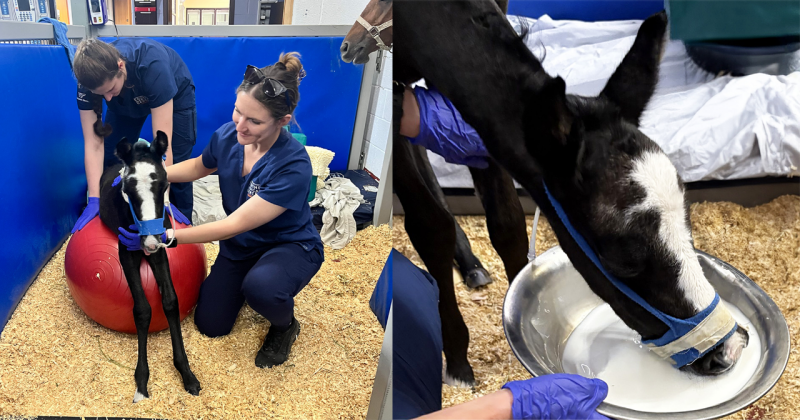
Nutmeg paddleboarding. Photo courtesy of Molly Cobbs.

Stephen A. Smith, professor of aquatic medicine and fish health, has worked with Blue Ridge Aquaculture since its 1993 founding and in other fish farm businesses at the same location in years prior.
“I have a 35-year career working with this particular facility, and my role has been as an outside contractor, where I'm making suggestions on not only the management but the welfare and the physiology and the health of these animals,” Smith said.
William R. Martin Jr., founder and CEO of Blue Ridge Aquaculture, described Smith’s role at Blue Ridge Aquaculture as “invaluable” in maintaining fish health by preventing, controlling, and combating disease.
Utilizing a recirculating aquaculture system, Blue Ridge Aquaculture cleans and recycles the water used in its tanks, and raises its fish without hormones or antibiotics and free of industrial pollutants such as mercury.
Martin sees Smith’s educational role, and Banos’ externship, as critically important for the future of the aquaculture industry.
“Bringing on an intern is wonderful, that gives us the opportunity to keep interacting with Virginia Tech. It gives Sebastien all the experiences he can't get anywhere elsewhere in the continental United States, in every aspect of fish health, through nutrition, the hatchery side, the brood stock, all of that.”
Banos was quite taken with the size and organization of the facility on his first day.
“Initially, the sheer size of the enclosures, the tanks, the size of the filters impressed me,” Banos said. “It's just on a scale of something I've never seen before. … This place really seems to be run like a well-oiled machine.”
Banos had a chance to put his own skills to work to help that well-oiled machine run even a little bit smoother.

“One of the skills that is highly valued for me is problem-solving,” Banos said. “Studying on the mixed animal track, I seek out opportunities to solve different problems with various species of animals. This is another opportunity for me to do that, to work with an unfamiliar species, where I can practice my problem-solving skills outside of the classroom and in a real-life setting.”
Banos’ externship gave him the opportunity to learn several aspects of aquaculture while traveling less than two hours from Blacksburg. He also has experience at two trout facilities and the Hill City AquaZoo public aquarium in Lynchburg, formerly known as SeaQuest Lynchburg.
“They get an experience in a modern, state-of-the-art aquaculture facility where they can put their veterinary education to use in such things as physiology, pharmacokinetics, biosecurity, infectious disease, and animal welfare,” Smith said of Banos and other students who have had a similar opportunity at Blue Ridge Aquaculture. “All those different things come to play in a facility like this.”
As with all externships as well as service within the veterinary college’s three teaching hospitals, it is about helping students nearing graduation to find their own paths in veterinary medicine by exposing them to different opportunities that they can’t get solely in a classroom.
“It will either help make him decide to go into aquaculture or not to go into aquaculture,” Smith said. “It helps the student decide where they want to go. It doesn't make a final decision, but it gives them a broadened scope of the veterinary profession. And that's what my goal is here, to mentor them, and help them see that there are a lot of things out there rather than just dogs and cats and horses.”
The future of aquaculture is near and dear to Smith.
“I think it's a very important discipline within the veterinary community,” Smith said. “Fish are the future protein source on this planet, over chickens, over any of the red meats. So as time goes on, it will become more and more important. And for the last 30-plus years, aquaculture has been the fastest growing section of the agricultural community. So we need to be prepared to be in that.”