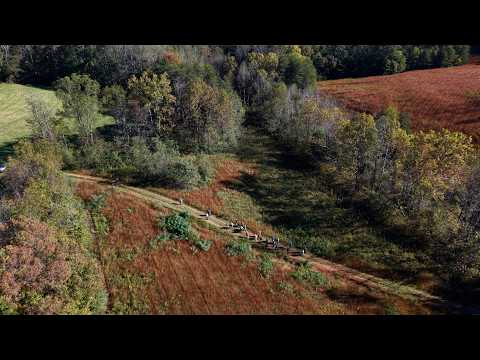
Can we save an imperiled pollinator?
Monarchs are butterflies that are native here to the eastern US. One generation a year is migratory. They will spend spring and summer here, and they range all the way up to Canada. But then in the fall, everyone turns south. Monarch butterflies have declined significantly in the last couple of decades. When we're trying to study and track the monarchs, we're going to attach a transmitter on them, and it is Bluetooth enabled. So, it will pick up on any device that has Bluetooth. Also any cell tower or Modus tower that they go by. One of the major challenges of invertebrate conservation and insect conservation in general is we don't have complete life histories of even something as iconic as the monarch. And understanding where these paths are, we can say, reduce pesticide usage here, make sure that there's more plantings done here. This is key information that we need, and this will make a huge difference. So my research focuses on incorporating compounds that could potentially deter monarch butterflies from laying her eggs and feeding on milkweed that has received insecticidal drift. So right now we've been screening some UV altering compounds, optical brighteners, sunscreens, trying to find a compound that could deter monarchs from laying her eggs on milkweed that farmers or pesticide applicators can incorporate into their applications. So now when the farmer goes across that field, if some of that insecticide drifts on to an adjacent milkweed plant, it carries that optical brightener, which changes the ultraviolet reflection of that milkweed plant. So now the monarch can identify that that plant has something wrong with it. They're one of those few animals that anybody can really help them out. Having a part of your yard as a small garden. Even if you don't have a yard, some potted plants. So it's not just something that scientists, like us, can do to help them.
Related Content
-
Video Item
 Engineers reimagine 3D metal printing , video Date: Nov 11, 2026
-
Video Item
 Virginia Tech research reaches orbit , video Date: Nov 09, 2026
-
Video Item
 Students learn filmmaking in unexpected places , video Date: Oct 30, 2026
-
Video Item