


Engineering students bring clean water access to rural Kenyan community
In the hills of Migori County in western Kenya, a crowd gathered this summer to watch something simple yet transformative: clear, cool water spilling from a newly drilled well.
For the rural community of Masara Steel, where families often walked hours to collect water that was sometimes unsafe to drink, the moment marked a turning point.
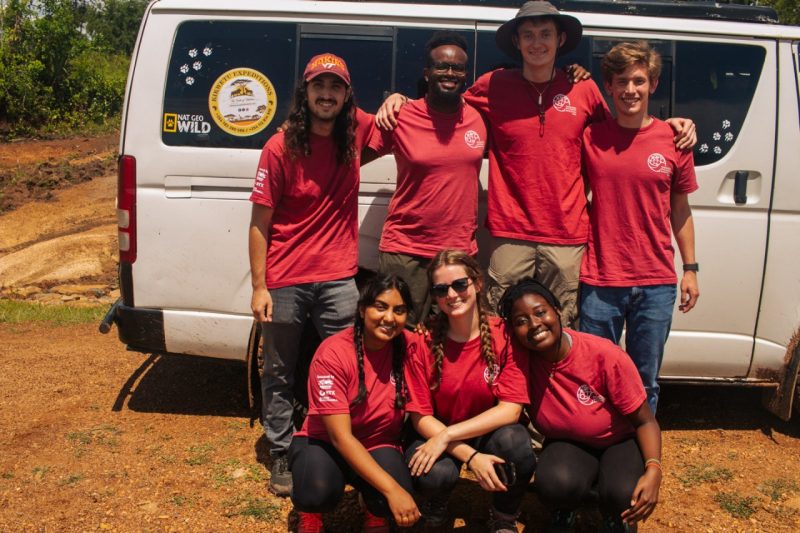
Helping make it possible were seven students from the College of Engineering. As part of Virginia Tech’s student chapter of Engineers Without Borders, team members spent three weeks in the community of Masara Steel, working with contractors and community members to drill and install a hand pump designed to deliver reliable access to clean water. The project represented the first in-person trip for the chapter since COVID-19.
Engineering with purpose
For the students, the work was more than an exercise in technical skills. It was a chance to embody Ut Prosim (That I May Serve), the university’s motto, in a global context.
“Engineers Without Borders is about so much more than building things,” said Ansley Bearden, president of the chapter and a senior studying industrial and systems engineering. “It’s about partnership. We listen to communities, learn from them, and then collaborate to design solutions that will last long after we leave. For Masara Steel, that meant tackling their biggest challenge: water security during both rainy and dry seasons.”
Bearden said while surface water is abundant in the rainy months, it is often contaminated by runoff from gold mining and agriculture, which can cause illness. During the dry season, families depend on small rainwater catchment tanks that quickly run dry. That cycle left the community vulnerable to waterborne illness and forced women and children to spend hours each day fetching water.
The students, working with the nonprofit Hydrating Humanity and an in-country contact, Paul Longo, opted to drill for groundwater and install hand pumps – an affordable first step that could later be expanded into solar-powered pumping and water distribution when flow rates are higher. Two wells have now been completed, and the team hopes to build two more in the coming years to reduce the burden on women and girls who walk long distances balancing heavy containers.


Building back momentum
The Kenya project has been years in the making. Member of Engineers Without Borders—Virginia Tech began planning in 2019, but COVID-19 stalled progress and funding. When Bearden joined as a first-year student in 2022, she found a student organization still recovering from the pandemic. “We were struggling with membership, engagement, and finances,” she said. “One of my biggest goals as a project lead was to rebuild that momentum so we could travel again. Being able to finally accomplish that at the end of my junior year was huge.”
The 2025 trip was made possible through extensive fundraising and sponsorship, including airline support from Emirates that allowed the group to bring seven students instead of just three. The team was joined by Chris Lombardo, a Harvard professor who mentors multiple Engineers Without Borders’ projects worldwide and provided technical oversight during drilling.
A team effort
The seven students represented a cross-section of engineering disciplines, from civil to mechanical to environmental engineering. Each brought skills that were essential to drilling oversight, surveying, and community engagement.
The team also conducted household surveys to better map the community and understand water needs. Translators – and students like Roy Gichuru, who grew up in Kenya and speaks Swahili – were critical in building trust and gathering information. “Talking directly with families helped us understand their daily reality in a way research alone never could,” Bearden said.
“This project means a lot to me personally, said Gichuru, an aerospace engineering major who co-led the project. “The same resonates for the rest of the group. Long-term sustainability for clean water access is a core mission for us. We want the infrastructure to keep operating for the children's grandchildren.”

For many, the most powerful moment came when women shared how water access ties into the broader challenges of health, safety, and education. Angel Ochieng, a Virginia Tech student whose family lives in western Kenya and who is fluent in Swahili and Luo, helped facilitate a women’s meeting where residents described the dangers of long walks for water and how often their daughters miss school to help.
“Some of the stories we heard were difficult to process,” said Ochieng, who is studying computational modeling and data analytics. “But these stories of resilience in the face of scarcity reminded me why this work matters, why showing up matters. I will carry the meaning and weight of this with me forever.”
Lasting impact in Masara Steel
The new wells provide reliable groundwater for families and livestock in Masara Steel, reducing the risk of waterborne illness and freeing up hours each day previously spent hauling water – time that can now be used for education or economic activity.
“One of the most powerful things we heard from local leaders was how water access ties to education,” said Bearden. “When kids don’t have to spend half the day collecting water, they can be in the classroom instead.”
Students also recognized the hard physical labor that hand pumps still require. “After a minute of pumping, I was exhausted,” Bearden said. “Women in the community do that day after day, then carry heavy containers for miles. Solarizing pumps is something they’ve asked for, and we hope to get there once conditions make sense.”
Looking ahead
For the Hokies who traveled this summer, the experience has left a lasting imprint.
“We are thankful to the university for its support,” Gichuru said. “Virginia Tech students were able to conduct undergraduate research alongside different cultures in a different country. [We’re grateful to] our sponsors as well, for providing resources to fulfill our chapter's missions.”
Back in Blacksburg, students are already fundraising and recruiting the next cohort. What began as a recovery effort after COVID-19 has turned into a movement, carried forward by students and mentors who see engineering not just as equations and designs, but as service.


