Engineering alum's medical startup aims to empower amputees with AI-linked prosthetics
Soham Mehra wears a headset prototype developed by the MorphLabs team. Photo courtesy of Soham Mehra.

Helping people in need and solving unique engineering problems. Those were the twin goals industrial and systems engineering alumnus Soham Mehra ’25 had as a student — and he found a way to accomplish them both by co-founding his own medical startup.
MorphLabs, the company he helps lead, builds noninvasive, AI-powered foundational models that build a bridge between brain and computer, allowing disabled people to control prosthetics and other assistive devices using just their minds.
The why
Mehra’s journey into the medical device world began during his internship at NuvoAir Medical, a startup focused on care for cardiopulmonary patients.
“[At this internship], I was building out AI agents and on-device deep learning models for clinics,” Mehra said. “The appeal of joining an early-stage startup was high for me, both for skill development and ownership, but also because of being at the cutting edge of the problems. The things you could work on had a direct carryover to helping people's lives.”
Throughout the fall semester of his senior year, Mehra explored startup opportunities. That’s how he met cofounders Pranai Reddy and Nick Cadavid who, at the time, were seniors from Rice University and Florida State University, respectively. After chatting in an online forum about their startup interests, they discovered their mutual curiosity surrounding healthcare.
“We got together and talked about all the things we could accomplish and the people we could help,” Mehra said. “One of my co-founders had a direct tie to working with amputees and distributing prosthetics when he was younger. We realized they are underserved members of our community, especially in the current medical system, and decided to work on building solutions for them.”
Following this initial meeting, Mehra and his co-founders soon began working on a brain-computer interface that could help these amputees control prosthetic limbs naturally with the use of a specialized headset and artificial intelligence.
Soham Mehra (left) poses with his MorphLabs collaborators. Photo courtesy of Soham Mehra.

The how
Whenever you move, your brain generates electrical signals that travel from your nervous systems to your muscles. The interfaces MorphLabs develops are meant to read intentions from the motor cortex, the portion of your brain responsible for movement, and send them to a prosthetic device.
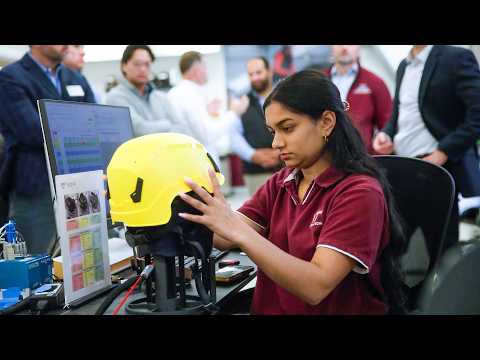
The specialized headset that Mehra and his team have designed uses sensors to clean up background interference and adaptive machine learning algorithm to translate brain signals into motor commands. Since everyone’s brain works differently, the use of artificial intelligence also allows the technology to adapt to a user over time.
The trio spent the rest of their senior year working on the technology together remotely, traveling to see each other, and winning pitch competitions, including the Virginia Tech Entrepreneur Challenge hosted by Apex Systems Center for Innovation and Entrepreneurship. After graduation, they moved in together so they could continue to build MorphLabs.
Eventually, Mehra and his cofounders realized the technology they were developing could solve problems beyond serving as a control system for prosthetics. The ability to augment the brain could offer a pathway to targeted cures and interventions.
“There are so many things that make us human, like the way you can share emotions physically,” Mehra said. “We want to create ways for everybody to enjoy those experiences themselves, whether it’s giving someone who has a missing hand the ability to shake their friend’s hand, allowing somebody who is paralyzed to travel the world, or providing someone who can't speak the ability to laugh and tell jokes with their friends. These are the things that make life beautiful. Being able to unlock that for everybody in the world, no matter where they're at or what kind of condition they’re in, is the goal.”
Soham Mehra (right) poses next to Nick Cadavid (left), who is wearing a headset developed by MorphLabs. Photo courtesy of Soham Mehra.

Right now, Mehra spends much of his time on experimentation and benchmarking with small tests to keep MorphLabs headed in the right direction. He has also been working closely with testers, collecting data to ensure the technology is safe and effective before it becomes officially available for public patent use.
“We're learning a lot about the regulatory space as we go and working with professionals and consultants to ensure we're on the correct path,” Mehra said. “It is a long road to get something through regulation, the FDA, and out to market. A lot of our current work centers on taking the technology we have and making sure it translates to a broader group beyond a small patient subset.”
Reflecting on undergrad
Mehra’s undergraduate experience was impactful, helping transform him into the leader he is today. He initially applied to Virginia Tech on a whim, but fell in love with campus when he first visited.
Industrial and systems engineering (ISE), he said, gave him the freedom to explore. Prior to MorphLabs, Mehra planned to become a strategy consultant and saw many of his peers go into manufacturing, software engineering, or product work. But what he learned has been equally helpful in entrepreneurship.
“My ISE background has helped me in two main ways,” Mehra said. “There is a supply chain and logistics element to our business, where classes like Production Planning and Inventory Control inform us. It also ingrained in me a systematic operational approach to designing processes, pipelines, workflows, and experiments. That approach was communicated implicitly through simulation and operations research classes.”
Mehra recalls his Virginia Tech years fondly, crediting much of his educational success to Michael Madigan and Rohit Kannan, both professors in the Grado Department of Industrial and Systems Engineering, as well as Associate Professor Joseph Wells in the Department of Mathematics.
“Your reasoning and ability to break down systems and figure out what an optimal set of constraints are in any situation will always remain an immensely valuable skill,” Mehra said. “That is something that comes across in the ISE major very effectively.”
During his time with the ISE department, he also served as president of the Virginia Tech’s Institute of Industrial and Systems Engineers (IISE) chapter.
“I learned a lot about dealing with both optimal and difficult situations where you have to communicate and set expectations,” Mehra said. “My peers in IISE did a lot for me too. Aziz Malouche, who ran IISE before me, was one of the most emotionally intelligent individuals I’ve ever met and someone I learned a lot from.”
The Virginia Tech IISE chapter during the 2024-2025 academic year. Photo courtesy of Soham Mehra.

The Virginia Tech IISE chapter during the 2024-2025 academic year. Photo courtesy of Soham Mehra.

Even though MorphLabs is in its early stages, Mehra has crucial advice for aspiring young entrepreneurs.
“Be shameless,” Mehra said. “There is no harm in not knowing anything, but you need to be comfortable and secure in that so you can ask for help.”