Helmet Lab receives Kellogg Community Engagement Scholarship Award

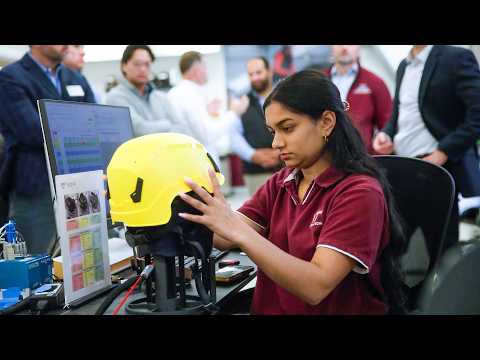
Last year, Virginia Tech biomedical engineering student Asha Patel helped test construction helmets in the Virginia Tech Helmet Lab. Months later, during an internship in a manufacturing setting, she found herself watching co-workers and contractors wearing the same kind of protective equipment she had studied.
“Every time I watched a co-worker or contractor wear a helmet, I was reminded of the importance of our work at the Helmet Lab,” Patel said. “Accidents happen, and protective equipment such as construction helmets are a critical line of defense.”
That connection between research and the people who use it is at the heart of the Helmet Lab’s work. As part of the Institute for Critical Technology and Applied Science, researchers and students work with athletes, workers, safety professionals, industry groups, and other partners to understand real-world injury risks, recreate those conditions in the laboratory, and turn the findings into independent helmet ratings and guidance available to the public.
“Our mission has always been to give people independent, research-based information they can understand and use,” said Steven Rowson, professor in the Department of Biomedical Engineering and director of the Helmet Lab. “Meeting a safety standard tells you whether a helmet meets a minimum requirement. We want people to understand how helmets perform relative to one another so they can make more informed decisions about protecting themselves and their families.”
That model of engaged research has earned the Helmet Lab recognition as a 2026 regional recipient of the W.K. Kellogg Foundation Community Engagement Scholarship Award, presented by the Association of Public and Land-grant Universities (APLU). The award recognizes programs that demonstrate strong community partnerships, meaningful public impact, and the integration of engagement with research and education.
As one of four regional recipients, the Helmet Lab also is a finalist for the C. Peter Magrath Community Engagement Scholarship Award, which will be announced in November.
“The Virginia Tech Helmet Lab exemplifies the power of engaged scholarship,” said Susan E. Short, senior associate vice president for outreach and international affairs. “Its researchers listen to the people confronting these risks, build rigorous research around their experiences, and translate the results into information that can protect people and improve lives.”
Research designed for public use
Since 2011, the Helmet Lab has developed independent helmet ratings that are freely available to the public. Its five-star system helps consumers compare how effectively helmets reduce injury risk, providing information that goes beyond the minimum pass-or-fail standards required for products on the market.
Researchers have developed rating systems for helmets used in football, hockey, cycling, soccer, equestrian sports, snow sports, whitewater sports, polo, flag football, and construction, and other activities.
For each category, researchers study the impacts people experience in real-world settings, recreate representative conditions in the lab, measure helmet performance, and translate the results into ratings people can understand.
The result is a public resource that helps people make more informed decisions about protective equipment. The ratings website receives about 2 million page views annually, and lab researchers respond to thousands of questions each year from athletes, parents, coaches, schools, employers, and others seeking guidance about head protection.
Community helps steer research
The Helmet Lab’s research starts outside the lab.
Community partners help researchers identify safety problems that need to be studied and determine what information would be most useful to people making decisions about protective equipment.
Ron L. White is president and founder of the California Football Alliance, a statewide organization that works to preserve, promote, and standardize youth tackle football. Before the ratings were available, he said, leagues often had to rely on field experience, manufacturers’ marketing, or even a helmet’s appearance when evaluating safety.
“We let data and science drive us, not marketing,” White said. “That’s really important from a consumer standpoint.”
The ratings have changed decisions on the field as well. White said his organization made a commitment to having its players wear only helmets that receive five-star ratings from Virginia Tech and shared the rating system with coaches, league administrators, officials, and families.
“It’s taken the guesswork out,” White said. “Parents can make an informed decision not because of what I’m saying to them as a league administrator, but what science is saying to them.”
That exchange works both ways. Community experience helps direct the lab’s research, while its findings give partners evidence they can use to make safety decisions.

Students learn by doing research that matters
Students are part of nearly every stage of the Helmet Lab’s work, gaining hands-on experience while contributing to research with direct public impact.
Undergraduate and graduate students help develop testing methods, build and modify equipment, conduct experiments, analyze data, and communicate findings. The recent construction helmet project alone involved about a dozen faculty members and students, with a graduate student leading the work as part of her master’s thesis.
Students can progress from learning laboratory practices and testing techniques alongside faculty and staff to conducting tests more independently. Patel said that combination of guidance and responsibility has helped her grow as an engineer in ways that are difficult to replicate in a classroom.
Students also have opportunities to interact with the companies and organizations connected to the work. Gavin Reichard, a senior majoring in mechanical engineering with a minor in biomedical engineering, has worked with testing rigs, data-acquisition systems, and engineering design while also meeting industry professionals who come to the lab to observe testing.
That experience helped him land an internship last summer with LIGHT Helmets, a football helmet company. Because of his work in the Helmet Lab, he arrived already comfortable with testing, prototyping, and data collection.
He said the lab also taught him something beyond technical skills.
A member of the Virginia Tech Rugby Club, Reichard said studying head impacts has made him more attentive to safety and the protective equipment used in his sport.
“The work we do is more than collecting data or completing a test,” Reichard said. “Our results can ultimately influence the decisions people make about their safety.
“Knowing that has given me a greater sense of responsibility not only for the work I do in the lab, but also for what I learn in the classroom, because I know that the knowledge I gain now will eventually shape the decisions I make as an engineer.”
Related:
Virginia Tech has twice previously received the Kellogg award: