Teaching Scholar Award comes full circle through connections beyond the classroom
Angela Anderson received the 2025 Large Class Teaching Award for face-to-face, community-building instruction and experiential learning that strengthen students’ engagement, and success.
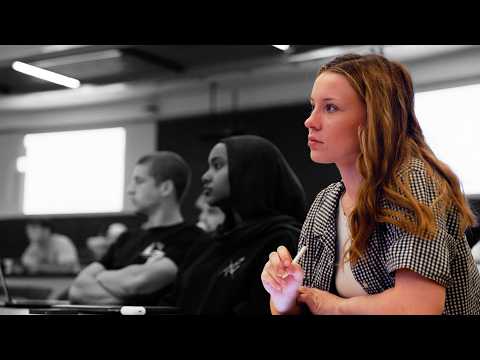
September 2, 2026 –Angela Anderson, collegiate associate professor in the Department of Human Nutrition, Foods, and Exercise, talks with students after her 4000-level Metabolic Nutrition class in the Graduate Life Center Auditorium at Virginia Tech. (Photo by Christina Franusich for Virginia Tech).

Before class begins, Angela Anderson poses a question that has nothing to do with physiology, nutrition, or exercise science: “If you could have any superpower, what would it be?”
Students turn to classmates they may never have spoken to before and begin talking. Anderson circulates the room, listening, laughing, and eventually sharing her own answer. The conversation lasts only a few minutes, but it reaches far beyond an icebreaker.
“It's low stakes,” Anderson said. “They don't feel like they have to share too much personal information, just enough that maybe they're building the framework for a friendship in the future.”
For Anderson, a collegiate associate professor in the Department of Human Nutrition, Foods, and Exercise, those moments of connection are foundational to learning, and part of what earned her the university’s 2025 Large Class Teaching Award from the Center for Excellence in Teaching and Learning.
In an era when students often arrive in classrooms already absorbed in digital devices, Anderson creates opportunities for them to engage with the people sitting nearby. Her recurring “Get to Know Your Neighbor” activity encourages students to strike up conversations that can become study partnerships or lasting friendships.
September 2, 2026 –Students in Angela Anderson’s 4000-level Metabolic Nutrition course work together during a small-group activity in the Graduate Life Center Auditorium at Virginia Tech. Anderson incorporates collaborative exercises into her large classes to encourage discussion, interaction, and active learning. (Photo by Christina Franusich for Virginia Tech).

Anderson frequently incorporates small-group activities into her courses, challenging students to solve situational problems together before sharing their ideas with the larger class. Beyond making lectures more interactive, research shows the approach improves learning and attendance.
“I am a strong believer in the value of face-to-face instruction,” said Anderson. “For this to be successful, students need to be present in class every week. On the flip side, as an educator, I need to make sure that the time I am with them in class is perceived as valuable for them and inspire them to invest in the material.”
Her approach also reflects the principles of the MUSIC Model of Motivation, developed by Brett Jones, a professor of educational psychology in the School of Education. The model identifies conditions that foster student engagement and motivation.
“The multiple recognitions that Dr. Anderson has received highlight the many ways she has blended her experience in the classroom with evidence-based pedagogical practices,” said Catherine Amelink, associate vice provost in the Office of the Executive Vice Provost and director of Center for Excellence in Teaching and Learning. “She creates opportunities for students to see direct relevance in classroom content to potential career pathways,” she added.
Learning on the move
When 30 Virginia Tech students traveled to Greenville, South Carolina, this spring for the annual Southeast American College of Sports Medicine meeting, Anderson made the trip a learning experience beyond the classroom. She connected students with people, ideas and opportunities shaping their future professions.
“Dr. Anderson made me feel seen and appreciated in a space that was new to me,” said Kate Schlageter-Prettyman, a first-year student in human nutrition, foods, and exercise. “I arrived with little to no sports medicine experience and left with a piqued interest in the field.”
For Schlageter-Prettyman, the conference's recurring emphasis on mentorship brought Anderson to mind.
“It is a word that Dr. Anderson embodies in every way,” she said.
September 2, 2026 –Angela Anderson shares an enthusiastic moment with a student after her 4000-level Metabolic Nutrition class in the Graduate Life Center Auditorium at Virginia Tech. Anderson describes her teaching style as “relational” and emphasizes getting to know students and supporting them beyond the classroom. (Photo by Christina Franusich for Virginia Tech).

“I want to build relationships with students, get to know their stories, and be their cheerleader,” Anderson said. “My classes aren't easy, but I'll provide the roadmap for success and cheer them on along the way.”
Upon returning to Blacksburg, Anderson asked each student to send a thank-you email to the department and college leaders who helped make the trip possible. More than a professional courtesy, the exercise encouraged students to consider how the research presented at the conference might shape their own career paths. Reading those reflections, Anderson said, was one of the most rewarding parts of the experience.
Anderson brings that same emphasis on experiential learning closer to home through partnerships with Virginia Tech Recreational Sports, giving students opportunities to tackle challenges similar to those they'll encounter as health care professionals.
Students undergo functional assessments themselves before developing exercise prescriptions for class. They also design evidence-based wellness initiatives for campus communities, including proposals for Hokie Movement activities and incentive programs that encourage physical activity among their peers.
“Who's better to ask how to get college students involved than current college students? They're working with real stakeholders,” Anderson said.
Whether she's fostering connections among hundreds of students, introducing undergraduates to their professional community, or partnering with campus organizations to tackle real-world challenges, Anderson's goal remains the same: to ensure students feel seen, connected, and prepared — not only to succeed in the classroom, but to become thoughtful, engaged members of their profession.